The Role of NVMe Storage in Improving Database Performance
Database performance is strongly influenced by the storage infrastructure used. When applications process thousands of requests every second, storage is often the source of the biggest bottleneck. If the storage system is slow, the process of reading and writing data will be hampered, resulting in slower response of the application.
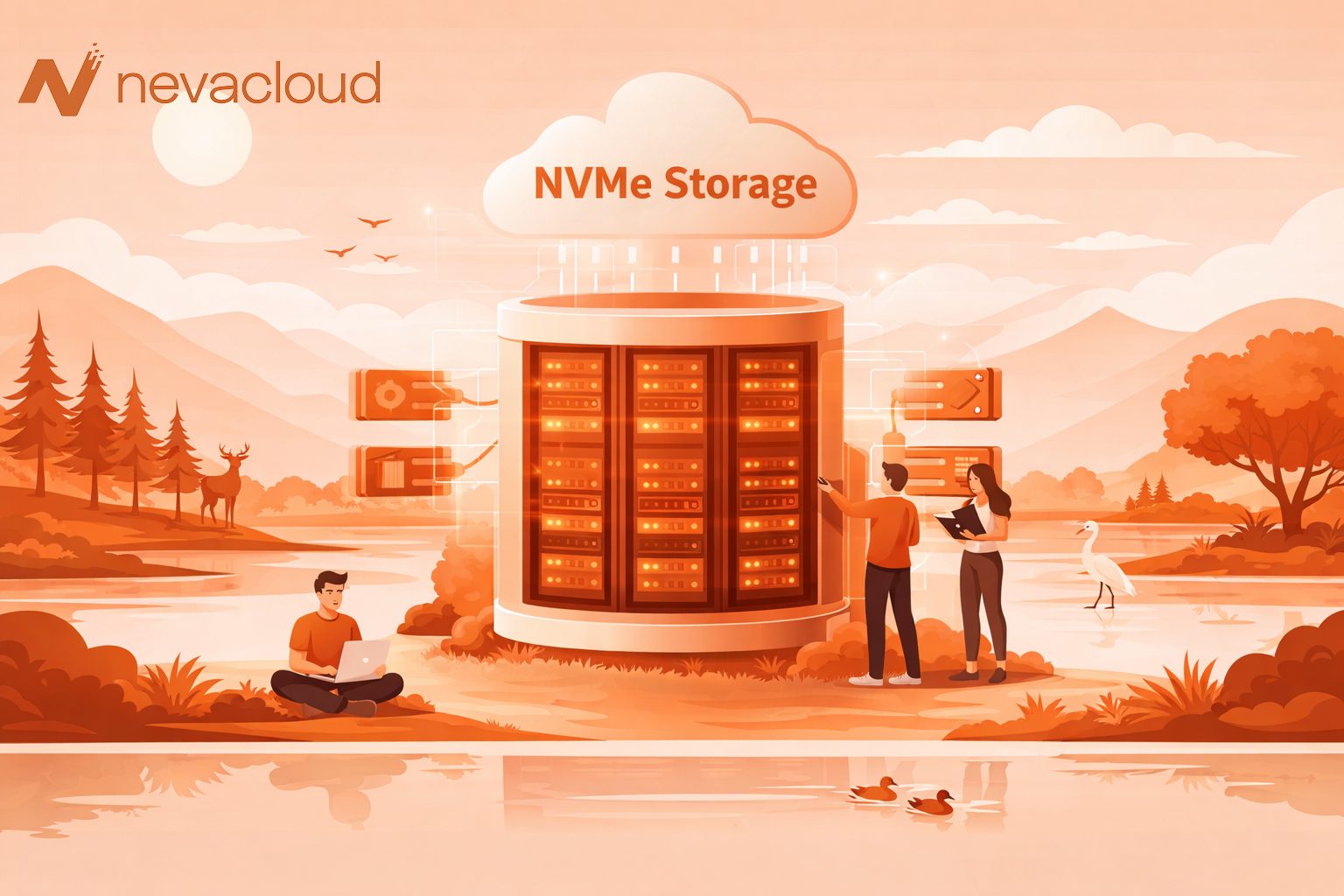
This is where NVMe technology begins to be widely used in modern server environments. NVMe storage is a storage solution based on the Non-Volatile Memory Express protocol designed to maximize the performance of SSDs over PCIe lanes. This technology is capable of providing low latency and high throughput.
For this reason, many modern database systems, such as MySQL, PostgreSQL, and MongoDB, use NVMe to improve query performance, accelerate transactions, and handle increasingly large data workloads.
Contents
What is NVMe storage?
NVMe storage is a storage technology that uses the Non-Volatile Memory Express (NVMe) protocol to access flash storage media via PCIe lanes. Unlike SATA SSDs which use the older interface, NVMe is specially designed to maximize the speed of SSDs.
With this architecture, NVMe is able to provide much lower latency and higher data throughput than traditional storage technology. The NVMe system also supports thousands of I/O queues in parallel, so that the process of reading and writing data can be completed faster.
Due to its high performance, NVMe is widely used in modern servers, data centers and cloud infrastructures. This technology is very suitable for workloads that require rapid access to data, such as databases, data analytics, SaaS applications, and systems with high transaction traffic.
How NVMe Storage Works
NVMe storage works using the Non-Volatile Memory Express protocol, which is specifically designed for flash storage media. This technology is connected to the CPU via a PCIe (Peripheral Component Interconnect Express) line, so the data transfer process is faster than the SATA interface.
Different from traditional storage, NVMe uses a parallel queuing system that allows thousands of input/output commands to be processed simultaneously. This mechanism reduces latency and significantly increases throughput.
Through direct communication between storage and processor, NVMe is able to maximize the performance of modern SSDs. As a result, the process of reading and writing data can be faster, especially in heavy workloads such as databases and cloud applications.
Benefits of NVMe storage
With high transfer speeds and low latency, NVMe storage is the first choice for workloads requiring rapid data access. Here are some of the key benefits of NVMe in server and database infrastructure.
1. Very low latency
One of the main advantages of NVMe is its extremely low latency. This technology is connected directly to the CPU via the PCIe lane, making the data communication process more efficient. In existing storage, data must pass through multiple layers of control before being processed by the processor. NVMe reduces this process so that response times are faster. This is particularly important for database applications that require real-time query response.
2. High IOPS performance
NVMe is capable of producing much higher input/output operations per second (IOPS) than SATA hard drives and SSDs. This technology supports thousands of I/O queues that allow many read and write operations to run in parallel. With this feature, the server can handle large workloads without experiencing a performance penalty.
3. Greater data throughput
NVMe uses much higher PCIe bandwidth than the SATA interface. This allows for faster data transfer. This high speed is very useful for applications that process large data sets, such as analytical systems, machine learning or data warehouses.
4. High scalability for modern infrastructure
NVMe is a technology designed to support modern infrastructure needs such as cloud computing and virtualization. This storage can be used on servers with large-scale configurations without encountering significant bottlenecks. Many cloud providers and data centers are now adopting NVMe to improve system performance and ensure service stability when traffic increases.
5. Database Workload Efficiency
Modern databases require high-performance storage to handle complex queries and large numbers of transactions. NVMe helps speed up the process of reading and writing data so that database performance increases significantly. This technology is often used in database systems such as MySQL, PostgreSQL, MongoDB and SQL Server.
The Role of NVMe Storage in Improving Database Performance
NVMe storage is a solution designed to overcome database performance limitations. With low latency and high throughput, NVMe is capable of accelerating various important processes in modern database systems. Here are some of his roles:
1. Speed up the database query process
Every database query requires the process of reading data from storage. If storage is slow, query execution time will increase. NVMe provides much faster data access than SATA hard drives or SSDs. With this speed, the database can retrieve data more efficiently. This helps improve the responsiveness of applications that rely on real-time queries.
2. Improve database transaction performance
Transaction databases such as e-commerce systems or financial applications process many read and write operations every second. Such workloads require storage with high IOPS capabilities. NVMe is capable of handling thousands of input/output operations in parallel. With this feature, the database can process transactions faster without experiencing a performance penalty when traffic increases.
3. Optimize the data analysis process
Many businesses use databases for their big data analysis and processing needs. This process typically involves complex queries that read large amounts of datasets. NVMe helps increase data throughput so that the analytical process runs faster. Report processing and data analysis times are also shorter.
4. Supports modern database workloads
Modern databases are not only used for simple data storage. Currently, many systems need to manage SaaS applications, cloud platforms, and even API-based services. NVMe storage provides stable performance for a variety of workloads. With fast, consistent access to data, database systems can support high-traffic applications without encountering bottlenecks.
Example of implementing NVMe storage in a database
With low latency and high IOPS capabilities, NVMe storage helps databases process data more efficiently. Here are several examples of implementing NVMe storage in different types of database systems.
1. Transactional database (OLTP)
Online Transaction Processing (OLTP) databases are used in applications that process transactions in real time. Examples are e-commerce platforms, digital payment systems and banking applications. In a system like this, thousands of transactions can take place every second. NVMe helps speed up the process of reading and writing data so that transactions can be processed without delay. As a result, the system remains responsive even if user traffic increases.
2. Analytical database and data warehouse
Analytical databases typically process large data sets to produce business reports or data insights. The queries executed are often complex and require reading large amounts of data. NVMe storage can increase data throughput so that the analysis process becomes faster. This helps sales teams achieve analytical results with less processing time.
3. Cloud Infrastructure Database
Many cloud providers use NVMe on their servers to improve the performance of database services. This technology allows virtual machines to access storage with low latency. Implementing NVMe on cloud infrastructure helps SaaS applications or API-based services run more stably. The database can handle high workloads without experiencing performance degradation.
4. Database Log and Cache Optimization
Some database administrators use NVMe to store transaction logs, temporary data, or database cache. This type of data often undergoes intensive reading and writing processes. With NVMe, the process of writing logs and retrieving data from cache can be faster. This strategy helps improve the overall efficiency of database performance.
Conclusion
NVMe storage is a modern storage technology that can significantly improve database performance. With low latency, high throughput and high IOPS capabilities, NVMe helps accelerate query, transaction and data analysis processes. This technology is well suited to a variety of modern database workloads, from SaaS applications to high-traffic systems.
To maximize this performance, using the right infrastructure is also an important factor. One solution is to use a cloud VPS from Nevacloud which is equipped with NVMe SSD technology up to 8 GB/s and 200,000 IOPS with 3X replication.
This infrastructure is also supported by AMD EPYC™ Genoa or Intel® Xeon® Platinum processors, fast DDR5 RAM and NVMe PCIe 5.0. By deploying a server in just 50 seconds and a high-speed network, Nevacloud is ready to help businesses run databases with more stable, fast and scalable performance.
PakarPBN
A Private Blog Network (PBN) is a collection of websites that are controlled by a single individual or organization and used primarily to build backlinks to a “money site” in order to influence its ranking in search engines such as Google. The core idea behind a PBN is based on the importance of backlinks in Google’s ranking algorithm. Since Google views backlinks as signals of authority and trust, some website owners attempt to artificially create these signals through a controlled network of sites.
In a typical PBN setup, the owner acquires expired or aged domains that already have existing authority, backlinks, and history. These domains are rebuilt with new content and hosted separately, often using different IP addresses, hosting providers, themes, and ownership details to make them appear unrelated. Within the content published on these sites, links are strategically placed that point to the main website the owner wants to rank higher. By doing this, the owner attempts to pass link equity (also known as “link juice”) from the PBN sites to the target website.
The purpose of a PBN is to give the impression that the target website is naturally earning links from multiple independent sources. If done effectively, this can temporarily improve keyword rankings, increase organic visibility, and drive more traffic from search results.