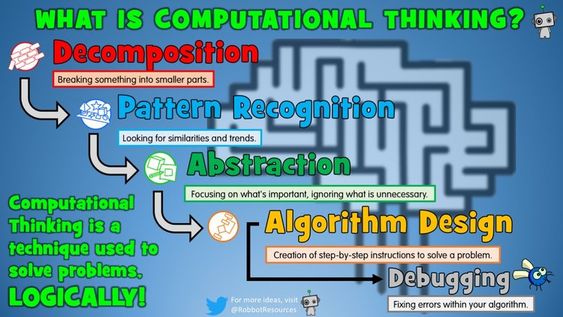
What is computational thinking?
Computational thinking (or perhaps if it is Indonesian it becomes computational thinking) is an approach that can be used to solve problems (problem solving). Brief computational thinking tries to solve problems by solving problems from a computational point of view. Even though it is closely related to software engineering, software programmers often do not implement it. computational thinking in software construction.
Contents
What is this computational thinking ?
Term Computational thinking first covered by Seymour Papert in his book “Mindstorm”. According to Jeannette Wing
Computational thinking is the thought process involved in formulating problems and their solutions so that the solutions are represented in a form that can be effectively executed by an information processing agent.
Computational thinking Basically a thinking pattern of breaking down a problem into smaller, simpler parts, finding the problem plan, and developing solution steps to solve the problem, for example in software creation.
Key capabilities in computational thinking
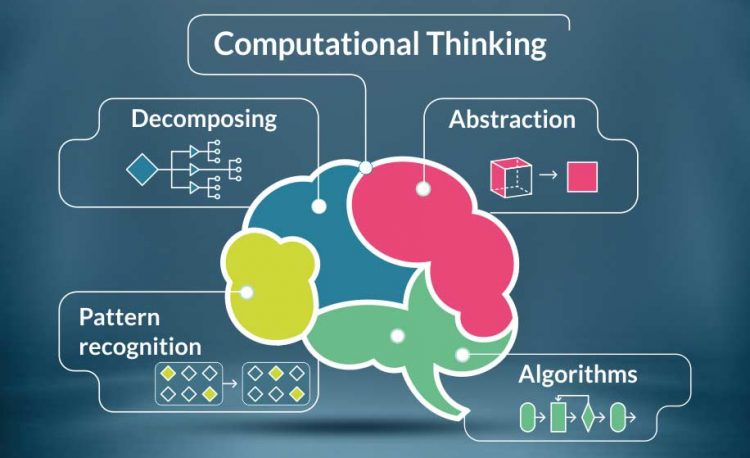
There are 4 key abilities in Computational thinking It is decomposition, pattern recognition, pattern abstraction, Dan algorithm design. And several other additional features, e.g. debugging. Let’s discuss them one by one.
Decomposition
Decomposition involves breaking down more complex problems into smaller, easier-to-solve problems.manage. Breaking down problems into smaller ones and getting to the core of a problem until we solve a problem can solve them one by one and identify the part where the problem is coming from.
Pattern recognition
Pattern recognition looks for patterns in a problem puzzle and decides if the problem/solution we found can be used to solve the current problem. By knowing the patterns, we can rethink appropriate solutions based on the patterns and solutions we have used in other problems.
Abstraction of patterns
Model abstraction or sometimes also called model generalization involves identifying general principles that produce patterns, trends, and regularities. One way is to model a problem to get the most general picture of a problem’s complexity.
Algorithm design
Algorithm design determines the necessary steps and rules to follow to achieve the desired goal. This step by step can often be used on other problems that also have the same pattern.
Other skills
In addition to the above abilities, several skills can help computational thinking It is debugging (systematic analysis and evaluation when a solution does not work as desired), and automation (a series of processes that can reduce resources in order to perform a task that needs to be done repeatedly so that it does not have to be done by humans).
Computational thinking can be applied in a very broad field, not only in software engineering. Approach computational thinking should be taught from childhood so that every individual is accustomed to problem solving and critical thinking. Especially if you look at today’s Indonesia, where people are very easily influenced by statements that seem easy but cannot be achieved because they are not used to thinking computationally.
Source:
PakarPBN
A Private Blog Network (PBN) is a collection of websites that are controlled by a single individual or organization and used primarily to build backlinks to a “money site” in order to influence its ranking in search engines such as Google. The core idea behind a PBN is based on the importance of backlinks in Google’s ranking algorithm. Since Google views backlinks as signals of authority and trust, some website owners attempt to artificially create these signals through a controlled network of sites.
In a typical PBN setup, the owner acquires expired or aged domains that already have existing authority, backlinks, and history. These domains are rebuilt with new content and hosted separately, often using different IP addresses, hosting providers, themes, and ownership details to make them appear unrelated. Within the content published on these sites, links are strategically placed that point to the main website the owner wants to rank higher. By doing this, the owner attempts to pass link equity (also known as “link juice”) from the PBN sites to the target website.
The purpose of a PBN is to give the impression that the target website is naturally earning links from multiple independent sources. If done effectively, this can temporarily improve keyword rankings, increase organic visibility, and drive more traffic from search results.

Related Posts

Borrow IDR 679 trillion from the bank
Slot Deposit Pulsa Indosat, Main Asik Tanpa Ribet