
Chinese New Year Food Recipes for Lunar New Year Feasts – Beragampengetahuan
These Chinese New Year food recipes come mainly from Cambodia, where the Chinese-Cambodian community celebrates Chinese New Year, and Vietnam, where Lunar New Year or Tết is celebrated. Some dishes are traditionally made for Lunar New Year offerings and family feasts, while others are special occasion dishes cooked and eaten year-round, not only for Chinese New Year. All have a place on the table during the spring festival.
Chinese New Year takes place on 29 January 2025, kicking off the Year of the Snake, and two weeks of celebrations that culminate in the Lantern Festival on 12 February 2025 in China, Hong Kong and Macau, and here in Cambodia and other countries with Chinese communities, such as Thailand, Myanmar, Malaysia, and Singapore.
If you’re celebrating Chinese New Year or Lunar New Year, or just using it as an excuse to cook Chinese food, browse our collections of Chinese fried rice recipes and Chinese egg recipes. We’ve got everything from marbled Chinese tea eggs and Chinese egg drop soup to egg foo young, both the Cantonese original and Chinese-American egg fu young with gravy.
Here in Cambodia the holiday is called Chinese New Year but it’s Lunar New Year in Vietnam and in East Asian countries that also follow the lunisolar calendar, such as Korea, Japan and Taiwan, as well as countries with citizens with Chinese heritage and Chinese diasporas, such as Australia, the UK and the North American countries.
We love getting into the spirit of the holiday here in Siem Reap, our home of ten years, making dumplings, frying spring rolls, slurping noodles, and spring cleaning. So we thought we’d share a round-up of Chinese New Year food recipes, which are predominantly Chinese-Cambodian recipes and a few recipes from Vietnam, where we lived before Cambodia, where Tet is celebrated.
Before I share this compilation of Chinese New Year food recipes, I have a favour to ask. beragampengetahuan is reader-supported. If you’ve enjoyed our recipes, please consider supporting beragampengetahuan by using our links to buy something on Amazon, such as these cookbooks by Australian chefs, classic cookbooks for serious cooks or gifts for Asian food lovers, or shop our beragampengetahuan store on Society6 for gifts for foodies, designed with Terence’s images.
Now let me tell you all about these Chinese New Year food recipes.
Contents
Chinese New Year Food Recipes from Cambodia and Vietnam for Your Lunar New Year Feasts
These are our favourite Chinese New Year food recipes for Lunar New Year feasts.
Egg Drop Soup Recipe for Egg Flower Soup Like Your Favourite Chinese Restaurant Makes
Our egg drop soup recipe makes an egg flower soup just like your favourite Chinese restaurant does – a velvety yellow soup so dense with creamy egg wisps that it’s almost like a liquid omelette. Slender slices of shiitake mushrooms ensure it isn’t! A drizzle of sesame oil, pinch of white pepper and sprinkle of spring onions complete this comforting broth.
This classic egg drop soup recipe will make you an ‘egg flower soup’, as the Chinese name literally translates to, which tastes just like the egg drop soup I grew up eating at our favourite neighbourhood Chinese restaurant in the western suburbs of Sydney. I imagine it tastes very much like a Chinese-American egg drop soup.
Egg drop soup is one of the most popular Chinese New Year food recipes as eggs are associated with fertility, birth and new beginnings. And we have more Chinese egg recipes here.
Egg Drop Soup Recipe for Egg Flower Soup Like Your Favourite Chinese Restaurant Makes
Chive and Pork Dumplings Recipe for the Cambodian-Chinese Take on Jiaozi
Dumplings are a lucky food for Lunar New Year and my Chinese-Cambodian friends tell me that Chinese New Year would not be complete without dumplings on the table for every Spring festival meal.
Families will often sit and make them together before New Year’s Eve and make enough to cover all holiday meals. This easy chive and pork dumplings recipe makes one of the most popular dumplings here in Cambodia. They’re essentially the Cambodian-Chinese version of jiaozi, the delicious dumplings found right across China.
In Cambodia, they’re often more rustic – no fancy pleating needed – and packed with chives and a little ground pork mince. We love dipping them in Sichuan-style chilli oil or a do-it-yourself sauce of chilli, soy and vinegar.
Easy Chive and Pork Dumplings Recipe for the Cambodian-Chinese Take on Jiaozi
Sichuan Style Wonton Recipe for the Sichuan Red Chilli Oil You Made
Easy to make, these spicy Sichuanese wontons have a pork filling that’s so perfectly seasoned you could eat them on your own. But why would you want to when you can generously douse them in some homemade Sichuan red chilli oil.
There are many different recipes for the pork filling for this Sichuan style wonton recipe, but the good ones all start with pork mince with a meat to fat ratio of 80/20. This allows the fat to render in the wonton while cooking, keeping the filling moist.
There’s an old Chinese tradition of stirring the pork mixture in one direction only for 3-4 minutes. The theory is that this keeps the filling tender and moist. And who am I to distrust an ancient Chinese tradition. It also helps to make sure all the ingredients are combined well.
Sichuan Style Wonton Recipe for That Sichuan Red Chilli Oil You Made
Cambodian Fried Spring Rolls Recipe for Crispy Deep-Fried Egg Rolls
No compilation of Chinese New Year food recipes would be complete without a recipe for spring rolls. Although eaten year-round nowadays, historically spring rolls were eaten for Chinese New Year and the Spring festival that followed.
While the origin of the spring roll is Chinese, and in Cambodia specifically its provenance is the Chinese-Cambodian community, these fried spring rolls are cooked and eaten by everyone in Cambodia these days.
This classic Cambodian fried spring rolls recipe makes a crunchy deep-fried spring roll filled with minced pork, dried shrimp, carrot, garlic, and daikon radish or taro, seasoned with fish sauce, Kampot pepper, sea salt, and palm sugar.
Fillings vary from region to region in China, but the pork mince-based mixture is nearly always marinated and the marinade typically includes any combination of oyster sauce (we like Lee Kum Kee Premium Oyster Sauce), soy sauces (we like to use these light and dark soy sauce brands), sesame oil, and perhaps Shaoxing cooking wine. We also have a tangy Cambodian fried spring roll dipping sauce recipe that you can make to serve with your spring rolls.
Cambodian Fried Spring Rolls Recipe for Crispy Deep-Fried Egg Rolls Just Like in Cambodia
Longevity Noodles Recipe for Lunar New Year for Long Life, Good Luck and Prosperity
One of our favourite Chinese New Year food recipes is this longevity noodles recipe for long life noodles. It’s a traditional Chinese noodle dish made during Chinese New Year or Lunar New Year to bring longevity, good luck and prosperity – as long as you don’t cut the noodles!
This is a super easy recipe, just take care not to break the noodles when you’re boiling them, stir-frying them or eating them, because if you do you’ll get bad luck! We buy a Singapore brand of longevity noodles here in Siem Reap produced by Hup Huat Noodles, to a recipe dating to 1930.
This brand on longevity noodles isn’t available on Amazon, but I’m sure you’ll find them or a similar noodle in an Asian market, specialty Asian grocer or a supermarket with well-stocked Asian sections. Ask for yi mein, yi mian, yee mein, yee fu or e-fu noodles. Good luck!
Longevity Noodles Recipe for Lunar New Year for Long Life, Good Luck and Prosperity
Cambodian Cha Mi Sou Recipe for Stir Fried Vermicelli Noodles for Khmer New Year
This Cambodian cha mi sou recipe for stir-fried vermicelli noodles with pork and mushrooms and a savoury sauce makes my take on a popular celebratory dish cooked for both Chinese New Year and Khmer New Year, as well as other special occasions in Cambodia.
A dish of Cambodian-Chinese heritage, cha mi sou is thought to have originated in China’s Fujian province, with cousins right across Southeast Asia. The savoury sauce is made from fish sauce, dark soy sauce and oyster sauce, the latter giving away its Chinese-Cambodian provenance.
An Asian kitchen essential, a wok is essential for stir-frying noodles. We recommend a cast iron wok with a long handle, but for effective stir-frying you really need high heat. A compromise is a round flat-bottomed non-stick wok.
Along with a classic Cambodian chicken curry and braised pork with palm sugar, cha mi sou is one of the most popular Cambodian dishes shared by families during the New Year periods and yet it’s perhaps one of the easiest celebratory dishes to cook.
Cambodian Cha Mi Sou Recipe for Stir Fried Vermicelli Noodles for Khmer New Year
Ginger Scallion Sauce Recipe for Ginger Scallion Noodles
While longevity noodles are a traditional Chinese New Year staple, friends tell me that these days in non-traditional households, any noodles are welcome on the table, as long as you follow the rules and don’t break the strands of noodles.
This ginger scallion sauce recipe for ginger scallion noodles makes the much-copied Momofuku homage to the classic Southern Chinese sauce that chef David Chang and food writer Francis Lam popularised over a decade ago.
Before we knew it as the Momofuku ginger scallion sauce for ginger scallion noodles from chef David Chang’s Momofuku: A Cookbook published back in October 2009, Chang said it was “the secret sauce” served up in Cantonese joints all over New York City. For Francis Lam, it was a Cantonese sauce served to accompany poached chicken and his mother gave him containers of it when he was away in college.
Ginger Scallion Sauce Recipe for Ginger Scallion Noodles – The Momofuku Homage to a Chinese Classic
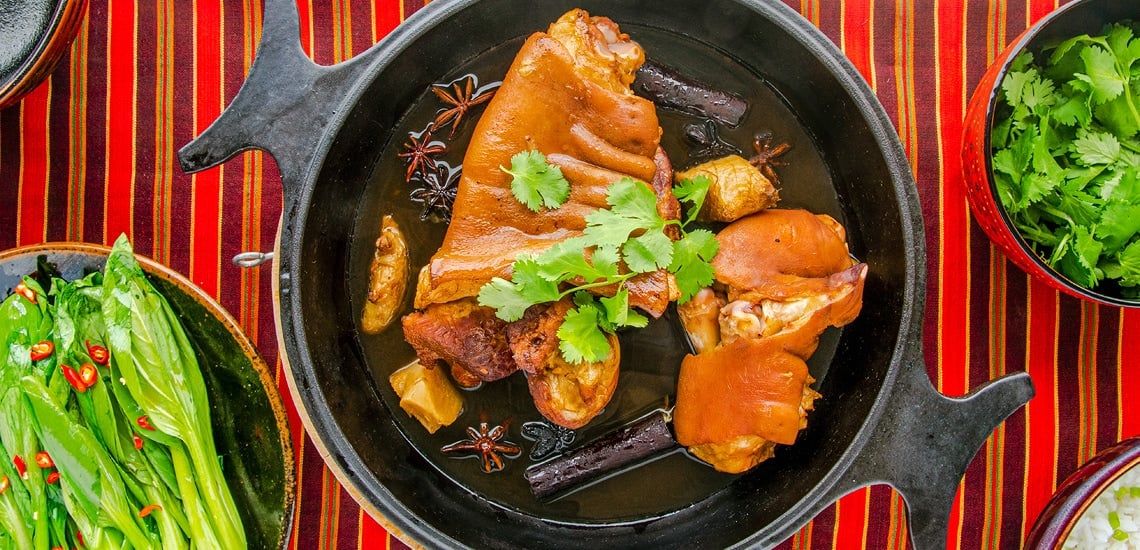
Slow-Cooked Pork Stew Recipe With Ginger and Star Anise for Khor Cheung Chrouk
Here in Cambodia, families who can afford to will buy a whole roasted piglet for Chinese New Year. Those who can’t will ensure there’s pork on the table for every Chinese New Year meal. This slow-cooked pork stew recipe makes an impressive and incredibly delicious dish.
While it takes some patience to make, it will fill your kitchen with the amazing aromas of pork, star anise and ginger. Served with fried spring rolls, dumplings, noodles, and stir-fried Asian greens, this Cambodian pork leg stew can be the centrepiece of a Lunar New Year feast.
One of the keys to making this slow-cooked pork stew recipe is that you need to find a good pork leg with plenty of meat to fat ratio. You do not want to go to the trouble of making this dish to find that 80% of your pork is actually fat – delicious as it is.
Terence uses his Dutch Oven to make the dish, placing a glass saucepan lid on top instead of the Dutch Oven lid so he can see how much stock is left in the oven.
Slow-Cooked Pork Stew Recipe With Ginger and Star Anise for Khor Cheung Chrouk
Char Siu Chinese Barbecue Pork Recipe
Char siu pork is another popular choice for Chinese New Year in Cambodia. Sweet and sticky on the outside, tender and juicy within, this Chinese barbecue pork recipe is super easy to make, it fills your kitchen with amazing aromas, and it’s very versatile.
For Chinese New Year, it will undoubtedly form one of numerous plates that comprise a holiday spread. After the Spring Festival, you can eat this just with steamed rice and Chinese greens and use any leftovers in fried rice or num pang or banh mi.
Char Siu Pork Recipe – How to Make Chinese Barbecue Pork
Crispy Five-Spice Pork Belly Recipe
Along with char siu, a five-spice crispy pork belly is a fantastic addition to a Chinese New Year feast. Five-spice or Chinese five-spice is a dry spice powder mix of ground cinnamon, cloves, fennel seeds, star anise, and Sichuan pepper that is traditionally used for Peking Duck, as well as a rub and in marinades for other dishes.
This is one of Terence’s favourite ways to cook pork belly and he’s been refining his version of this dish for years. It isn’t a labour-intensive dish, but the pork requires a couple of days of fridge time before final serving.
After the pork belly is cooked through, the cooled-off pork goes back in the refrigerator for at least another 12 hours, weighed down to make the pork perfectly even in height. The pork then goes back into the oven to get the skin perfectly crispy. While the presentation here is modern, you can present it in a traditional form for a family meal.
Five-Spice Crispy Pork Belly Recipe – A Refined Rendition for a Dinner Party
Vietnamese Braised Pork Belly and Eggs Recipe for Thit Kho Tau to Celebrate Lunar New Year
This Vietnamese braised pork belly and eggs recipe makes thịt kho tàu, also called thịt kho hột vịt, a rich dish of sweet and salty, melt-in-the-mouth, caramelised pork belly simmered slowly with boiled eggs. While it’s eaten all year in Vietnam, it was a traditional dish for Tết, the Vietnamese Lunar New Year.
Thịt kho tàu has long been one of our favourite Vietnamese dishes and while we used to eat it whenever we had the opportunity when we lived in Vietnam, it started out in life as an essential dish on family tables during Lunar New Year holiday of Tết.
This particular version of this caramelised pork belly and eggs dish has its provenance in Southern Vietnam, as the inclusion of fish sauce, coconut water and palm sugar give away, however, there is a similar dish that hails from Northern Vietnam, and you’ll also find similar braised pork and boiled eggs dishes all over Southeast Asia and China.
Vietnamese Braised Pork Belly and Eggs Recipe for Thit Kho Tau to Celebrate Lunar New Year
Stir-Fried Chicken with Cashews Recipe for Cambodia’s Take on Cashew Chicken
In Cambodian families of mixed cultural heritage – Chinese-Cambodian and Khmer – a chicken or chicken dish will often take pride of place instead of a roast piglet. It won’t just be any chicken dish, rather it will be something luxurious, like this stir-fried chicken with cashews recipe for cha moan krop svay chanti.
This Cambodian favourite has its origins in China, in a dish that is a cross between a Sichuanese dish and a Cantonese speciality, so it’s not so out of place on the Chinese New Year table after all. Found elsewhere in Southeast Asia, including Thailand, it’s also similar to a dish known as ‘cashew chicken’ in the USA and Australia and it’s incredibly delicious.
Stir-Fried Chicken with Cashews Recipe for Cambodia’s Take on Cashew Chicken
Chinese Special Fried Rice Recipe
This Chinese special fried dish is also called Yangzhou fried rice, because its provenance is the city of Yangzhou in Jiangsu province in China, which was one of the culinary hotbeds of Huaiyang cuisine.
The traditional version of this Chinese special fried rice dish includes cooked rice, char siu pork, shrimps, scallions, ‘scrambled’ eggs, peas, and carrots. Sea cucumber and crab meat are other additions.
Some recipes use lap cheong (or lap chong) instead of char siu pork. Growing up in Australia, this special fried rice was served at every suburban Chinese restaurant in Australia, not to mention at those old-school Cantonese ‘all you can eat’ restaurants that were in every city and town’s Chinatown, so it has a special place in the hearts of nostalgic Australians, especially during Chinese holidays.
Chinese Special Fried Rice Recipe, a Fantastic Filling One Pot Meal
Stir Fried Morning Glory or Water Spinach Recipe
Southeast Asian greens, such as stir-fried morning glory or water spinach, called char trokuon in Cambodia, are not considered one of the lucky foods that you would traditionally have on the Lunar New Year table.
However, no meal in Cambodian is complete without a plate of stir-fried greens or a salad, and is almost one element of a spread of dishes, centred around rice, no matter what the holiday or occasion.
Stir Fried Morning Glory or Water Spinach Recipe for Cambodia’s Char Trokuon
Chinese Lion’s Head Meatballs Recipe
This Chinese lions head meatballs recipe makes shizi tou, fried melt-in-the-mouth pork meatballs braised with Chinese cabbage. A classic of Huaiyang cuisine, traditionally the meatballs were enormous, each sitting on a cabbage leaf which forms the mane.
My meatballs are cub-sized for convenience as much as to avoid wastage. The recipe is adapted from legendary Chinese-born, Hong Kong-raised culinary historian and cookery writer Yan-Kit’s Classic Chinese Cookbook.
Chinese lions head meatballs originated in Yangchow, in China’s Kiangsu Province. The earliest incarnation of the dish was first created by a chef in the palace of Emperor Yang way back during the Sui Dynasty (589-618AD).
While the large meatballs are said to resemble lion’s heads and the frilly ends of Chinese cabbage their manes, Emperor Yang actually asked his chef to create a dish that reminded him of the sunflowers he’d spotted in the countryside on a journey, but that’s another story.
Chinese Lion’s Head Meatballs Recipe for Tender Pork Meatballs Braised with Cabbage
Published 1 February 2022, Updated and Republished 13 January 2025
Please do let us know in the comments below if you make any of these Chinese New Year food recipes as we’d love to know how they turn out for you.

travel terdekat
travel agent
mobil travel, travel bag, travel umroh, travel jakarta bandung, travel, baraya travel
#Chinese #Year #Food #Recipes #Lunar #Year #Feasts

Related Posts

Rasakan hidup dalam kecepatan penuh dengan Kartu Toyota Platinum baru dari Metrobank – Beragampengetahuan

Cara mempersiapkan perjalanan jangka panjang: Panduan praktis sebelum Anda pergi – Beragampengetahuan
