

Northern Spain to Costa Brava: A Pyrenees Van Adventure – Beragampengetahuan
A slow family road trip through valleys, vineyards, and volcanic forests
There’s something magical about hitting the road with your family in a slightly-too-old motorhome. It coughs a bit on climbs, the brakes smell funny on descents if you aren’t careful enough to use the engine brakes, but it becomes your tiny moving home through mountains, vineyards, medieval towns, and Mediterranean coves.
In September 2025, we packed our lives into ours and left Galicia for a 24-day loop that would take us across northern Spain, into France, through Andorra, and back home via the Costa Brava and Ribera del Duero. With my partner, our three-year-old daughter, and a weary map full of plans, we rolled east on a journey that was part family adventure, part endurance test, part love letter to slow travel.
Contents
Why This Route Works
We’re not mountain conquerors. Our vintage vehicle overheats if you look at it wrong, so this route was designed for valleys, tunnels, and scenic detours instead of high passes.

Still, there were some high passes to climb.
It’s also perfect for anyone traveling with small kids or slow engines: short drives (4–5 hours max), easy walks (2–5 km), plenty of free overnight parking, and a mix of nature, small towns, and the occasional pool, river, beach, or spa stop.
Northern Spain, French Pyrenees & Costa Brava: Our Itinerary
The Journey Begins: Galicia to Burgos
We left the damp Galician coast behind, spent a quiet night in Pedrouzo, then drove through Lugo for an impromptu BBQ lunch in Baralla—embers already glowing—before rolling east across Castilla’s golden plains toward Burgos.

This river is a 2 min stroll away from Baralla’s motorhome free area
Burgos greeted us with crisp air and its imposing Gothic cathedral. Tapas bars, leafy promenades, and the sense that we’d truly begun moving. Try the local morcilla if you dare — it’s not for everyone, but it doesn’t get more Burgos than that!
From Burgos, we followed the Ebro into La Rioja, where vineyards roll endlessly toward Laguardia — a walled town seemingly painted onto its hilltop.
-

- Laguardia on a sunny September sunday morning

We spent a leisurely Sunday afternoon there, hopping between a couple of local restaurants for lunch before heading to the town pool — closing for the season that very day — to cool off as temperatures neared 30°C.

Laguardia outdoor public pools have some of the most fascinating views I’ve ever seen.
Although we had planned to stop for tapas along Logroño’s famous Calle Laurel, we decided to skip it; cities can feel less inviting sometimes, can’t they? We also passed on Olite’s fairytale streets, knowing their main festivities would make the night as busy — and noisy — as it gets.
Instead, it was Ujué that stole the show. We parked by the ancient walls, climbed the cobbled lanes in complete silence, and from the top watched fireworks burst far across the valley, somewhere near Olite.
No crowds, no plans — just us, the stars, and distant flashes of light. It felt as though the whole plain was celebrating.
The French Pyrenees: Fog, Faith & Forest Roads
Crossing into France, the weather changed its mind. The morning fog near Roncesvalles / Orreaga was so dense it felt like driving inside a dream.
We had slept the night before near a pilgrims’ ward, sharing a €14 set-menu dinner of soup, trout or chicken, and red wine with Camino walkers — strangers, but for one evening, family.

La Posada restaurant, in Orreaga Roncesvalles, serves an affordable daily dinner menu for pilgrims.
Next came Saint-Jean-Pied-de-Port, tucked in the French Basque hills. We only followed the reverse Camino for a short stretch between Roncesvalles and here, but it was enough to feel the quiet rhythm of the route—pilgrims heading west, us heading east. Familiar France greeted us again with its stone houses, soft light, and that unmistakable mix of calm and character.

Serene palette in Southern France.
By the time we reached Lourdes, we were ready for something surreal. It’s hard to describe: part shrine, part Disneyland of devotion.

Lourdes’ architecture is a complex of three basilicas, a Gothic and a Roman Byzantine style church, with the largest underground crypt in the world, all built around the grotto where the Virgin Mary is said to have appeared.
But its vast underground basilica — a concrete amphitheater for 25,000 people — was breathtaking, both holy and bizarre. Faith, scale, and humanity are all intertwined.

Basilica of the Immaculate Conception, Lourdes.
Then came the drive south — mountain after mountain, each curve a reminder that the Pyrenees are not just a border but a living spine.
After a Capvern overnight pause, we stopped in Saint-Bertrand-de-Comminges, hiking up to the old town (a laughable climb for little legs) and pausing to admire its stunning cathedral.
Val d’Aran: Mountains, Magic, and Kindness
Back in Spain, Val d’Aran felt like stepping into another world — alpine meadows, slate-roofed villages, and air that made you breathe differently.

Captured from our motorhome’s window near Vielha, Val d’Aran.
We began walking Tredós’ Camí de les Bruixes – the Witches Path – between Vielha and Baqueira, a forest loop filled with carved witches and old mountain legends. Our daughter loved every minute of it.
From there, we followed the trail from Pla de Beret to Montgarri, walking under rolling clouds until, as dusk fell, a local stopped and offered us a ride back — without us even asking him directly.

The hike from Pla de Beret to Montgarri is a scenic trek through lush valleys and alpine meadows, offering breathtaking views of the Pyrenees.
Kindness has its own radar.
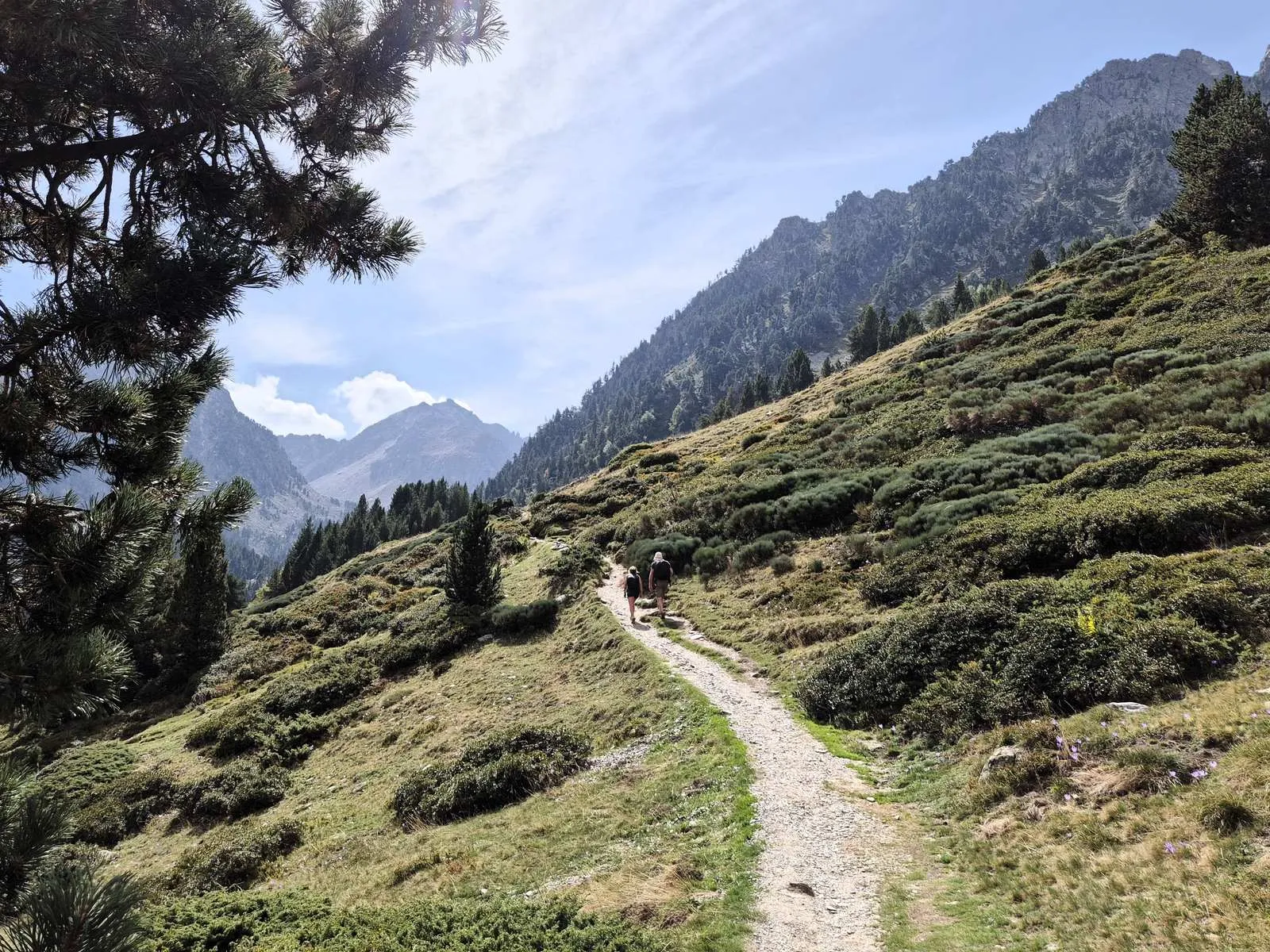
The Gerber Lakes Walk winds past three stunning alpine lakes, with peaceful waters framed by rugged mountain scenery.
And finally, we set out for the first of the Gerber Lakes — the Estanyola de Gerber — that icy-blue mirror tucked among the peaks.

Estanyola de Gerber, a serene alpine lake surrounded by dramatic peaks.
One of us stayed back midway with our daughter while the other continued up the steep path, just far enough to see where the valley turned to water and stone.
Andorra: Storms, Lunch, and a Quick Goodbye
We spent a couple of slow, easy days between Rialp and La Seu d’Urgell, two fantastic spots for overnight parking surrounded by mountain views and crisp September air.
In Rialp, the village was buzzing with the Matxicots trail race—runners dashing through muddy tracks as the river swelled with post-storm water.
The hillsides were dotted with chestnut trees just beginning to turn, and we even found a bookcrossing stop tucked inside a tiny old bus shelter, a sweet reminder of how small gestures can make a place feel alive.

The Cloister of La Seu d’Urgell is a peaceful, historic space where Romanesque arches frame tranquil gardens.
La Seu d’Urgell, our last stop before Andorra, offered a calmer rhythm.

La Seu d’Urgell’s covered streets offer shaded paths with shops and cafés, perfect for rainy days!
We wandered through its Romanesque cathedral and old quarter, letting the sense of history settle in before heading up the valley—arriving in Andorra la Vella just as the first rumbles of a thunderstorm began to echo off the peaks.
A few hours after leaving the tiny country, the sky opened up — lightning flashing, temperatures dropping fast. We only stayed long enough for a warm lunch and a short walk before realizing snow was on the way. Then we turned the van south again, chasing clearer skies and the smell of autumn instead of frost.
Garrotxa & Banyoles: Forests That Breathe

La Garrotxa is known for its volcanic landscapes and charming towns.
The beech forest of Fageda d’en Jordà is the kind of place that makes you speak softly — tall trunks, dark volcanic soil, and leaves glowing amber in the light.

The shorter route through Fageda d’en Jordà is about 2km long, takes roughly 45–60 minutes to walk, and passes through dense beech forest growing over old lava flows from the Croscat volcano.
We paid €5 for parking — one of only two times we did on the whole trip — and wandered for a couple of hours between showers.

Nearby the aforementioned volcano.
After lunch, we tried to reach the St. Margarita volcano but turned back as electric storms rolled in fast.

Olot’s Botanical Garden features a peaceful lake surrounded by diverse plant collections and walking paths.
By the time we reached Olot — greener and larger than we’d imagined — it was pouring.
The next day, we spent a full day exploring: Castelfollit,

The Llierca Bridge spans 36 meters over the Llierca River in La Garrotxa and dates back to the 16th century.
the Llierca bridge,
and Besalú, before arriving in Banyoles just in time for a quiet afternoon by the lake.
No rain, no rush — just still water and a deep breath out.
The Coastal Arc: From Collioure to Cap de Creus
We crossed north again into France to visit Collioure, the pastel harbor town that once inspired Matisse and Picasso. The air smelled of salt and crepes; the streets hummed with slow joy.
We followed the D914 coastal road south — a winding ribbon between sea and cliffs.
After leaving behind Paulilles, Banyuls-sur-Mer, Port-Vendres, and Cerbère, we crossed the French–Spanish border and reached Portbou.

Portbou is a small coastal town in Catalonia near the French border, known for its railway station and rugged Mediterranean cliffs.
It brought back teenage memories of playing in my hometown’s orchestra — our late conductor had written a calm, beautiful piece called Portbou Sarajevo, and the name still strikes a chord.

Nestled on Catalonia’s Costa Brava, El Port de la Selva is a fishing village known for its harbor, beaches, and fresh seafood.
After a quick stop in El Port de la Selva, we reached Cadaqués, where rumba music drifted through the streets and small art galleries stayed open late on a warm Saturday night.
The town had that effortless Mediterranean charm—whitewashed walls, laughter in the air, and the kind of energy that makes you want to stay just one more day.

Jose kayaking near Cap de Creus.
The following morning, we kayaked the turquoise coves of Cap de Creus, gliding past Dalí’s house in Portlligat.
Roses was where we parked that night.
Our only real pause came in Cala Montgó, where we stayed two nights — swimming, drying towels on the van mirrors, letting time dissolve.
Cala Montgó, a sheltered beach near L’Escala, is perfect for swimming, snorkeling, and kayaking.
We even got lost one evening on a cliff trail until a kind local couple rescued us and drove us back in time for sunset. These are the people you remember long after the landscapes blur.
Monasterio de Piedra – Water in the Desert
On our way back west, we detoured to the Monasterio de Piedra — a lush canyon of waterfalls and moss tucked into Aragón’s dry plains. The contrast was so striking it felt like stepping into a secret portal: roaring water, echoing caves, and green light filtering through leaves.
Bodegas Pandora – Verdejo & Laughter
In Rueda, we stopped at Bodegas Pandora for a tasting of crisp Verdejo. It was easygoing and human — more storytelling than marketing. Just perfect!
Home Stretch: Wine, Family & Farewell Feasts
The final days blurred into warm reunions and full hearts. Lunch with Asia’s great-grandmother near Valladolid. Beers (that turned into dinner) with Jose’s old university gang. And the last night — a soul-warming Senegalese domoda stew cooked by my friend María and her partner Baba in Vilardevós.
Tomatoes from my friend’s vegetable garden.
The next day, after almost a month on the road, 3,150 kilometers, and countless memories, the van — dusty, squeaky, and proud — carried us home to the Galician seaside.

Traversing northern Spain in a vintage motorhome offers scenic coastal roads, charming villages, and a slow-paced, nostalgic adventure.
How Much Did Our 24-Day Van Trip Really Cost?
After nearly a month of exploring Spain and France, here’s what it all added up to (for two adults — our three-year-old rides free):
| Category | Total | Notes |
|---|---|---|
| Diesel | €432.42 | 3,150 km, 10.5 L/100 km, €1.34/L. Freedom fuel. |
| Restaurants & Meals | €627.40 | About 20 meals out — from pilgrim menus to seaside cafés. |
| Supermarkets | €367.86 | Ten stops for fresh food and snacks. |
| Parking | €12.00 | Only paid twice: Fageda (€5) + Andorra (€7). |
| Other Expenses | €50.45 | Kayak rental, toddler sneakers, tolls. |
| Personal Treats | €100.00 each | Coffees, books, small joys. |
💶Total: €1,690.13 — €845 per adult, around €70 a day for the three of us (2 adults, one kid). Neither cheap nor costly, but worth every cent if you ask us!

The three of us ready to start the Gerber lakes hike.
Explore the Route on Our Interactive Map
If you want to follow our journey—or plan your own—here’s the full interactive map of our 24-day campervan loop through northern Spain, southern France, Andorra, and the Costa Brava.
Zoom in to explore each stop and driving segment from foggy Roncesvalles to the bright coves of Cala Montgó.
👉 View the Trip Map on Tripline
(Best viewed on mobile in landscape mode or on a desktop for the full route experience.)
Tips for Future Van Travelers
- Avoid steep passes if your van (or nerves) runs hot. Valleys are your friends.
- Travel slowly. 3 weeks minimum for this route; 4 if you can.
- Eat like locals. Weekday menus are affordable and filling.
- Carry cash. Small towns, big surprises.
- Libraries and pools are your friends. You can work, play, chill, and even take a shower or shelter in case of bad weather conditions!

Lourdes’ main library is one of a kind
- Don’t chase the plan. The best stories happen when you detour.
Because in the end, the best journeys don’t just take you somewhere — they change the way you see everything, including home.
Wondering what a family road trip through Southern France and Northern Spain really looks like? Get a glimpse of the unforgettable moments that made this adventure one for the books!
travel terdekat
travel agent
mobil travel, travel bag, travel umroh, travel jakarta bandung, travel, baraya travel
#Northern #Spain #Costa #Brava #Pyrenees #Van #Adventure

Related Posts

Rasakan hidup dalam kecepatan penuh dengan Kartu Toyota Platinum baru dari Metrobank – Beragampengetahuan
Cara mempersiapkan perjalanan jangka panjang: Panduan praktis sebelum Anda pergi – Beragampengetahuan
